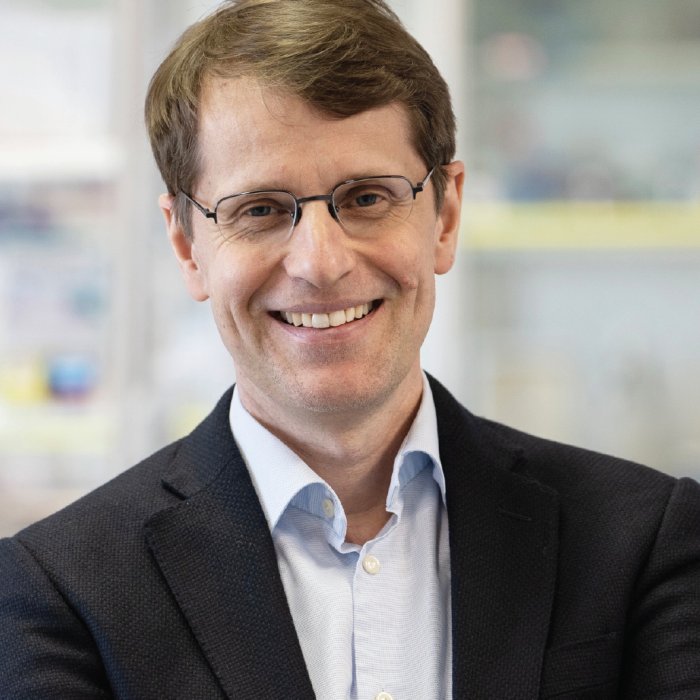
Frontiers brings home its first top researcher: Botond Roska to form a research group in Hungary
The internationally renowned, Wolf Prize–winning neurobiologist’s gene therapy developments offer new hope in treatment for people with visual impairments or blindness. As the first Fellow of Frontiers, he will build a knowledge center in Hungary.
“Botond Roska is redefining how we understand and restore vision. We are honored by his trust in bringing this extraordinary knowledge and resource to Hungary,” said Ferenc Krausz, initiator of the Frontiers Foundation, at the announcement. He described Roska as a Renaissance man, whose wide-ranging interests span from classical music to mathematics. He emphasized that one of the distinguished neurobiologist’s greatest strengths is his consistent ability to translate research results into practice, linking basic research with clinical applications.
Botond Roska stated that joining the Frontiers Program is a special opportunity for him to elevate scientific work in Hungary, which will attract talent. The Knowledge Center established under the auspices of Frontiers is the result of a long-standing collaboration. One of the pillars of the research is a unique method unparalleled in the world, along with studies focusing on how to sustain the human brain and how to influence nerve cells. The center is set to launch this summer. At the announcement, Roska also recalled that when he received the Wolf Prize, Ferenc Krausz and Balázs Hankó were among the first to call and congratulate him.
The announcement follows just a few days after the cornerstone-laying ceremony of the Frontiers Campus, marking the physical basis of a new scientific ecosystem. Frontiers represents the environment of cutting-edge research in Hungary. It does not build parallel projects but rather an ecosystem: a space where excellence attracted excellence, and research groups, connected in an international network, create new knowledge. Within this community—operating at the intersection of natural sciences, medicine, health sciences, and engineering—the shared standard accelerates thinking, and collaboration opens new directions.
The Frontiers Fellow community is formed by invitation. It is not an application process but a scientific recognition. Its members are internationally influential researchers at the most dynamic stages of their careers, who build and lead research groups in Hungary while expanding the boundaries of discovery and seeking practical applications.
Botond Roska’s work embodies this approach. His research focuses on the retina, which, as part of the brain, allows for cell-level investigation and targeted intervention in the nervous system. His team and discoveries have contributed to the partial restoration of vision in blind patients, opening new directions in the treatment of neurological diseases. Within Frontiers, he is building a research environment where basic research, technological development, and clinical application operate within a single system.
The announcement directly follows the laying of the foundation stone of the Frontiers Campus, held on March 31 in Budapest. Nobel Prize–winning physicist Ferenc Krausz, initiator of the Frontiers Foundation, emphasized at the event that Hungary’s key resource is knowledge built on talent without borders. The Frontiers Campus is not merely a research center, but an ecosystem spanning from talent development to cutting-edge research, and from fundamental science to societal application.
As Krausz Ferenc put it, the laying of the foundation stone is also a commitment to long-term investment in knowledge. The goal is to create an environment where the spark of curiosity leads to discovery, and where the world’s best researchers and most talented young people work and grow side by side.